Platform Engineering Has a New Consumer: AI Agents
We’re a digital engineering team focused on building secure, AI-driven, and scalable systems. From intelligent automation to cloud-native development, we turn complex challenges into powerful, future-ready solutions — one line of code at a time.
AI AgentsPlatform engineering was built around a fairly straightforward assumption: the person consuming the platform is a developer. A developer needs an environment, a deployment workflow, access to infrastructure, observability, secrets, databases, and other shared capabilities. Instead of asking every development team to understand how all of those systems work internally, a platform team provides standardized interfaces and workflows that make common operations easier and safer.
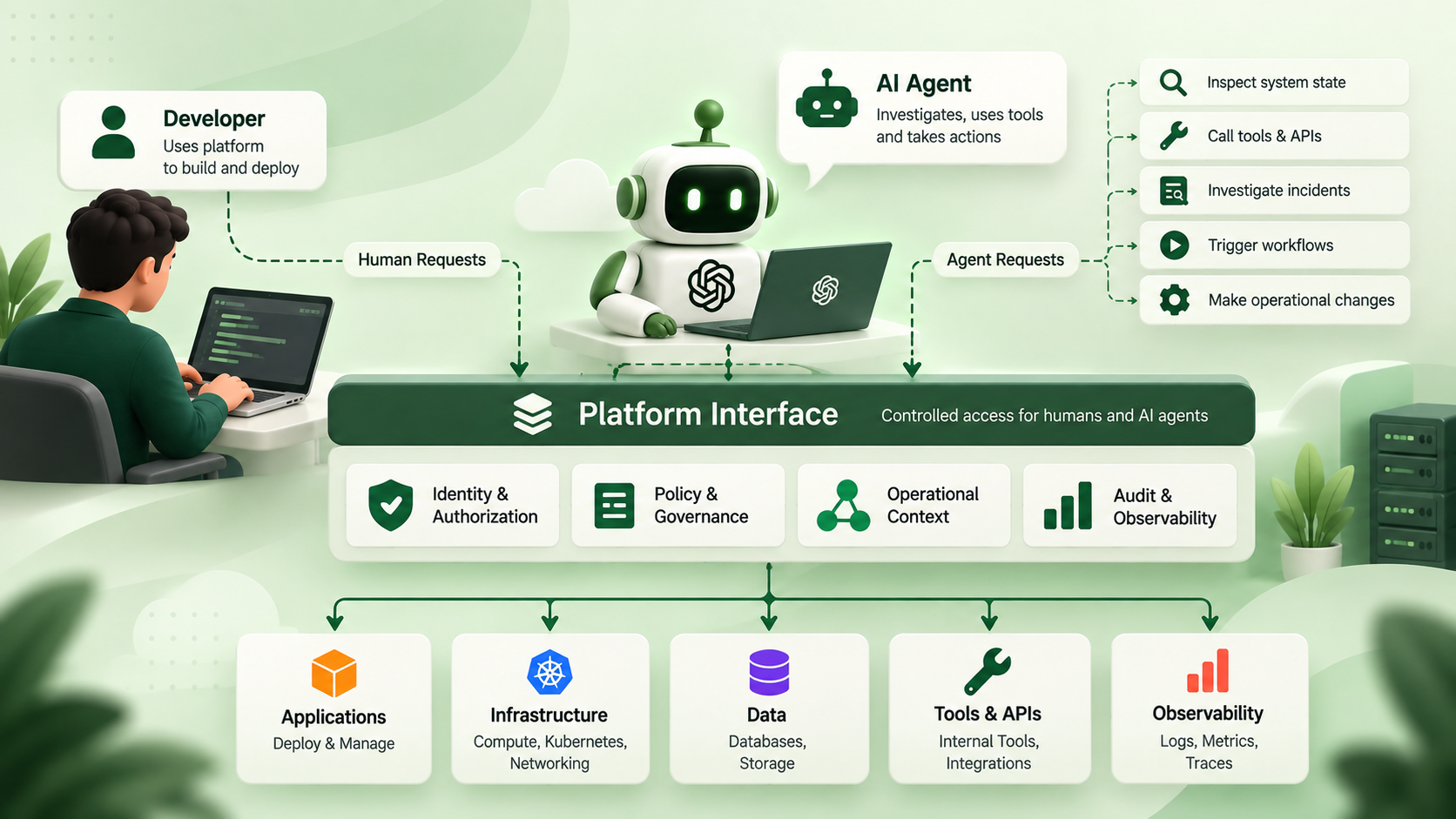
That model has worked because the developer remains the decision-maker. AI agents introduce a different kind of platform consumer. An agent can inspect system state, call tools, investigate incidents, interact with APIs, trigger workflows, and potentially make operational changes without a human explicitly executing every step.
This does not mean that platform engineering needs to expose more APIs to AI.
The more important change is that the platform now has to manage software actors that can take actions. Recent CNCF discussions describe AI agents as emerging consumers of internal platforms alongside developers, platform engineers, and SREs. The shift affects not only how platforms expose capabilities, but also how they handle identity, permissions, context, governance, observability, and lifecycle management.
The original platform model was designed for humans
The rise of internal developer platforms came from a practical problem. Modern applications depend on too many underlying systems for every development team to manage them independently. Kubernetes, cloud infrastructure, networking, identity, CI/CD, observability, databases, security controls, and deployment policies all introduce operational complexity.
Platform engineering creates an abstraction around that complexity. A developer can request an approved environment or deployment without needing to understand every implementation detail behind it. The platform provides the workflow, applies organizational standards, and exposes only the capabilities the developer needs.
This is often described as platform-as-a-product: the platform team builds a reusable product for internal consumers rather than simply maintaining a collection of infrastructure tools.
The important detail is that the consumer is still human. A developer can understand an error message, decide whether a change is appropriate, stop halfway through a workflow, ask another engineer for help, or recognize that a particular action is unusual.
An AI agent behaves differently. It can execute the same workflow repeatedly. It can react to telemetry at machine speed. It can call several tools during a single investigation. It can continue operating after the original request has been made.
That creates a new operational question:
What should happen when the consumer of a platform can make decisions and initiate actions without a human directly executing each operation?
The answer should not be to give the agent unrestricted access to the systems underneath the platform. The platform boundary becomes more important.
Agents should consume platform capabilities, not bypass them
An organization could give an agent direct access to Kubernetes, cloud APIs, databases, monitoring systems, ticketing systems, and other operational tools. At first, that can look attractive. The agent has everything it needs to investigate problems and perform actions.
The operational problem appears later. Every direct integration becomes another place where identity, authorization, secrets, auditing, rate limits, failure handling, and resource boundaries have to be defined. The agent can gradually become an alternative operations layer that sits outside the organization's existing platform controls. That defeats much of the purpose of platform engineering.
A stronger model is to make the platform the controlled interface between the agent and the underlying environment.
AI Agent
   |
   |  governed requests
   v
Platform Interface
   |
   +-- Identity & Authorization
   +-- Policy & Approval
   +-- Operational Context
   +-- Audit & Observability
   |
   v
Platform Capabilities
   |
   +-- Applications
   +-- Infrastructure
   +-- Data
   +-- Operational Services
The exact implementation can use APIs, CLIs, workflow systems, tool interfaces, or protocols such as MCP. The architectural principle is more important than the specific interface:
An agent should consume capabilities that already have operational boundaries instead of receiving unrestricted access to the systems behind those capabilities.
CNCF's recent discussion of agentic platform engineering makes a similar distinction. Human users and AI agents may interact through different interfaces, but their actions should still operate under consistent identity, permission, governance, and audit controls.
The platform needs to understand context
Giving an agent access to platform APIs solves only part of the problem. Consider an agent investigating elevated latency in a production service.
The useful question is not simply whether the service is returning errors. The agent may also need to know which team owns the service, whether a deployment happened recently, which dependencies are involved, whether those dependencies are healthy, whether the service is operating during a maintenance window, and which remediation actions are permitted. That information usually exists across multiple systems.
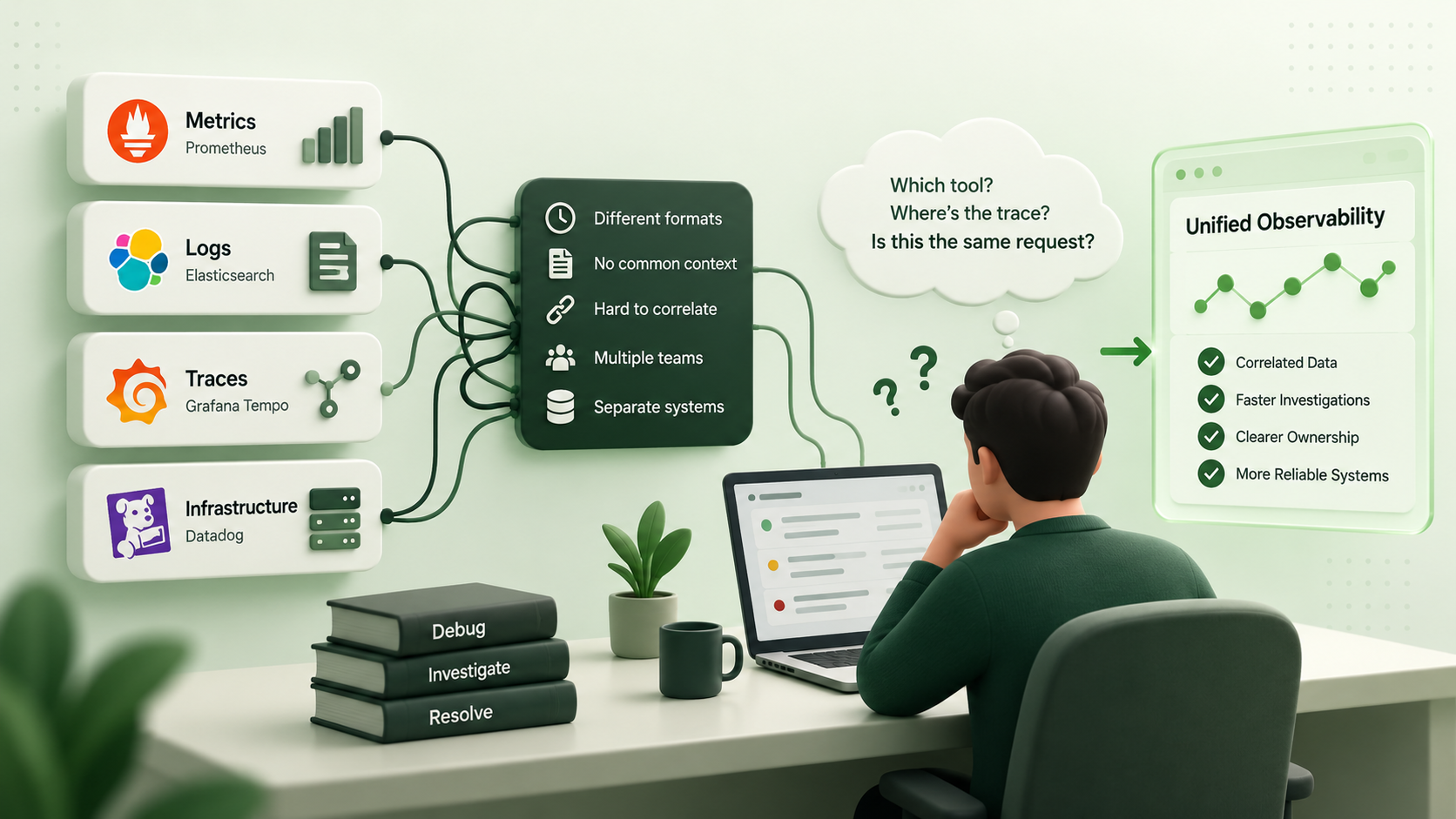
Logs contain events. Metrics contain measurements. Traces show request paths. Deployment systems contain release history. Infrastructure systems contain resource state. Ownership information may live somewhere else entirely.
A human engineer can mentally combine these sources. An agent needs a machine-accessible representation of the same context. This is one of the more important changes for platform engineering. The platform increasingly needs to understand relationships between applications, resources, ownership, dependencies, policies, and operational history instead of treating each system as an isolated tool.
CNCF's July 2026 discussion describes this as a move toward context becoming a first-class platform capability. The argument is that agents need more than raw telemetry; they need relationships and operational context that allow them to reason about the system they are operating.
This distinction matters because an API that returns a deployment status tells an agent what happened. A platform that can also identify the service owner, relevant dependencies, recent changes, applicable policies, and permitted remediation actions gives the agent information about what that event means. That is much closer to the context an experienced operator uses during an incident.
Self-service becomes more powerful—and more dangerous
Self-service is one of the core ideas behind platform engineering. Instead of opening a ticket for every environment, database, deployment, or operational request, developers can use approved workflows themselves. AI agents make that capability significantly more powerful because they can invoke those workflows repeatedly and automatically. That also changes the failure mode.
If a human selects the wrong option in a self-service workflow, the mistake may happen once. An agent can make the same mistake across multiple resources or continue repeating it because its interpretation of the system has not changed. This means platform capabilities exposed to agents need stronger boundaries than simply “the API accepts this request.”
A useful platform capability should define what the operation can affect, which identities can invoke it, which environments are allowed, whether human approval is required, and what happens when the operation fails. For example, a restart operation might be permitted for a non-critical service with sufficient redundancy but require approval when the affected resource is a primary database.
The important point is that these constraints should be enforced by the platform. They should not depend on the model remembering a paragraph of operational guidance.
AI can recommend an action; the platform should enforce the boundary
This leads to an important separation between reasoning and control. An AI model can determine that a service appears unhealthy and recommend restarting it. The model can consider logs, traces, recent changes, and historical information when reaching that recommendation. But the model should not be the final authority on whether the restart is allowed.
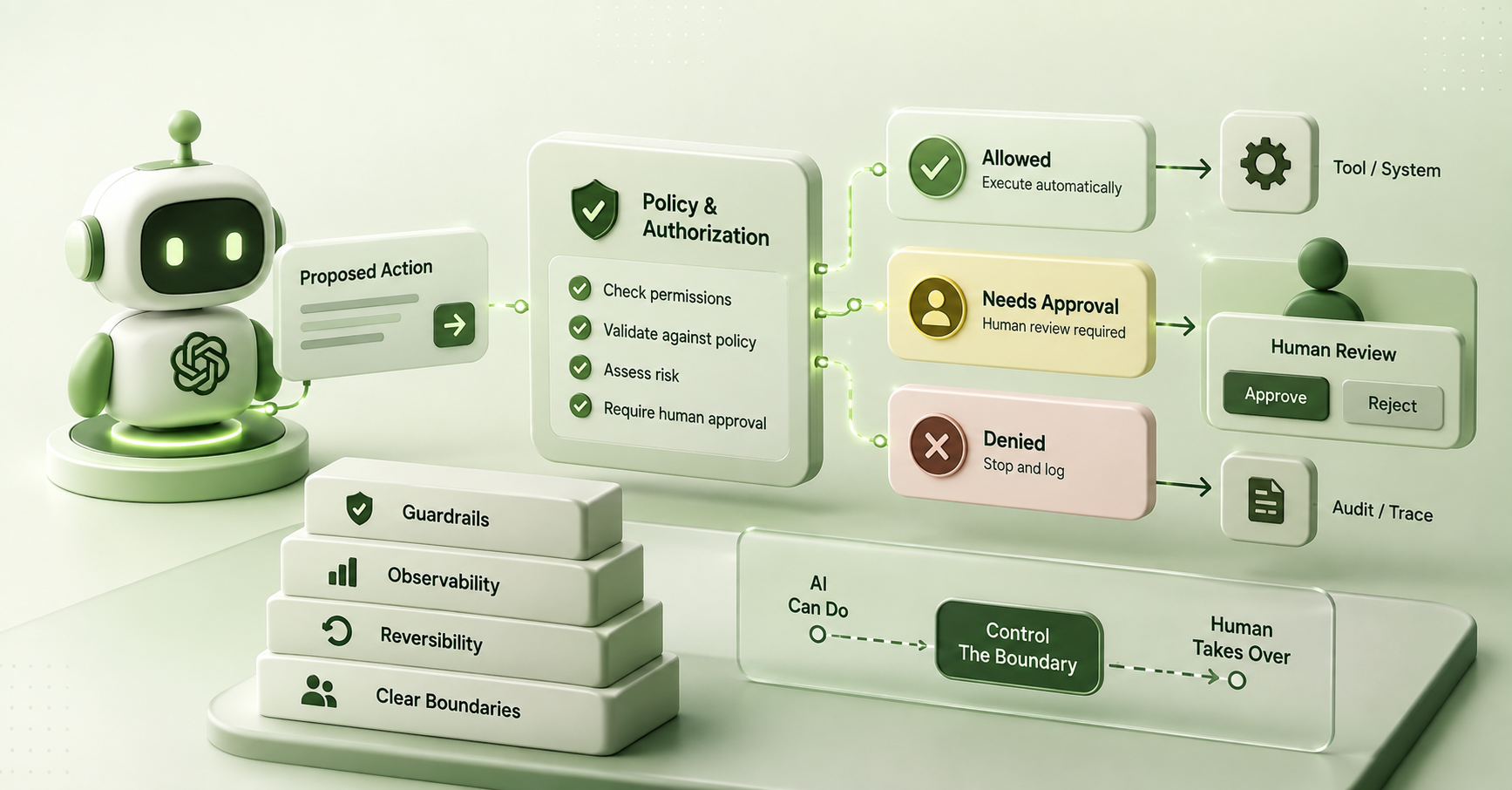
The platform should make that decision using deterministic controls. It can verify the agent's identity, check resource ownership, evaluate authorization, apply environment-specific policy, determine whether the action requires approval, and record the operation for later investigation. That creates a useful division of responsibility.
The AI handles reasoning over ambiguous information. The platform handles deterministic enforcement. This separation becomes increasingly important as agents move from producing recommendations toward taking operational actions. CNCF's current platform-engineering discussion similarly identifies AI agents as non-human consumers that need their own identity, scope, and governance rather than being treated as ordinary human users. A practical architecture therefore looks less like “model decides and executes” and more like:
Agent reasoning
      ↓
Proposed action
      ↓
Platform authorization and policy
      ↓
Controlled execution
      ↓
Observed result
      ↓
Audit and updated context
The model remains useful without becoming the security boundary.
Observability becomes part of the agent interface
There is another consequence that is easy to overlook. If an agent is expected to operate production systems, observability is no longer useful only for humans.
The platform needs to expose operational information in a way that agents can consume without giving them unrestricted access to every monitoring system. Suppose an agent is asked to investigate an API that has become slower.
A useful investigation might require recent deployment information, service health, dependency status, trace data, resource saturation, queue depth, active incidents, and ownership information.
The platform can expose those signals as a governed operational capability rather than forcing the agent to independently discover and authenticate against every underlying system. This changes the role of observability.
It remains a mechanism for humans to understand system behavior, but it also becomes part of the machine interface through which software actors understand the environment they operate in. That makes consistency particularly important.
If the human dashboard says that a service is healthy while an agent receives a completely different representation of the same state, the organization effectively has two operational realities. A shared platform context can reduce that divergence.
Agents need a lifecycle too
Applications have lifecycle management because production software cannot be treated as something that simply appears and runs forever.
The same principle applies to AI agents. Once an agent can access production resources, the organization needs to know which agent exists, who owns it, what it can access, what tools it can invoke, which version is running, which policies apply, and when its access should be revoked.
This is more than an authentication problem. An agent may change over time because its underlying model changes, its prompts or instructions change, its tools change, or the surrounding platform changes. A previously safe workflow can therefore behave differently after a seemingly unrelated modification.
Platform engineering can provide the lifecycle controls around that agent. Registration, identity, capability assignment, policy evaluation, deployment, monitoring, version changes, access rotation, and retirement become platform concerns when the agent is operating as part of the production environment.
Treating an operational agent as a temporary script makes those responsibilities easy to overlook. Treating it as a managed software asset makes them explicit.
The platform should serve different interfaces without creating different rules
Human developers and AI agents do not need to interact with a platform in the same way. A developer may prefer a portal or CLI. An SRE may work through GitOps and operational tooling. An automated system may use APIs. An AI agent may interact through a controlled tool interface. Those interfaces can remain different. What should not become different is the underlying operating model.
The same resource ownership should apply regardless of who requested an operation. The same security policy should govern access. The same audit trail should record important actions. The same operational context should describe the system. This is where platform engineering can provide a useful abstraction.
The goal is not to make every consumer use the same interface. The goal is to make different interfaces operate against the same set of governed platform capabilities. That gives the organization one operational model rather than a separate model for developers and another for agents.
Do not build a second operations platform for AI
There is a natural temptation to create a dedicated “agent platform” beside the existing developer platform. That platform may have its own identity system, policy layer, observability stack, resource abstractions, workflow engine, and operational dashboards.
Over time, the organization can end up with two systems solving overlapping problems.
The existing platform governs applications. The agent platform governs agents. A separate system tracks agent actions. Another system manages the resources that agents are allowed to use.
The resulting architecture can recreate the fragmentation that platform engineering was originally introduced to reduce.
A more sustainable approach is to extend the existing platform model. AI agents become another category of platform consumer. Their interfaces can be different, and their permissions can be more constrained, but they operate against the same foundational concepts of identity, policy, resources, observability, ownership, and lifecycle.
Recent CNCF work describes this direction as an evolution of platform engineering rather than a completely separate discipline: the platform expands to support additional consumers and AI-era requirements while retaining the core ideas of self-service, platform-as-product, governance, and standardized workflows.
What platform teams should change first?
Organizations do not need to rebuild their entire internal platform simply because they are introducing AI agents. A more practical starting point is to examine the capabilities that an agent is likely to consume.
Identify the existing APIs and workflows that perform operational actions. Determine which actions are reversible and which are not. Establish ownership for the resources involved. Make authorization boundaries explicit. Identify operations that require human approval. Improve the quality of operational context available through the platform.
This exercise often reveals gaps that already existed before AI entered the picture. An undocumented production procedure is difficult for a human engineer to use consistently. It is even harder to expose safely to an agent. An operation with unclear ownership is an organizational problem regardless of whether the request comes from a developer or an AI system.
A workflow without reliable observability is difficult to automate safely regardless of the automation technology. AI therefore exposes weaknesses in the platform that may have previously been hidden behind human judgment.
That can be useful. Instead of starting with “How do we build an agent platform?”, platform teams can start with a more concrete question:
Which existing platform capabilities are safe enough, observable enough, and well-defined enough to be consumed by software actors? The answer provides a much more useful roadmap.
Platform engineering becomes the control plane for software actors
AI agents do not make platform engineering less important. They make the platform boundary more consequential.
Once software can independently inspect systems, choose actions, and invoke operational workflows, organizations need stronger answers to questions that platform teams have already been responsible for:
Who is allowed to perform this operation?
Which resource can it affect?
Under what conditions is the operation permitted?
What context should be available before the action is taken?
How is the action observed?
What happens when it fails?
Who owns the result?
When must a human approve or take over?
These are not questions that a model should answer by itself. They belong in the surrounding system.
The next stage of platform engineering is therefore not simply about giving AI access to infrastructure. It is about extending the platform so that applications, infrastructure, humans, and AI agents can operate within the same governed environment.
The model may decide that an action is useful. The platform should determine whether that action is allowed. That distinction is likely to become one of the most important boundaries in production AI systems.