Identity Is a Runtime Boundary, Not an IAM Checklist
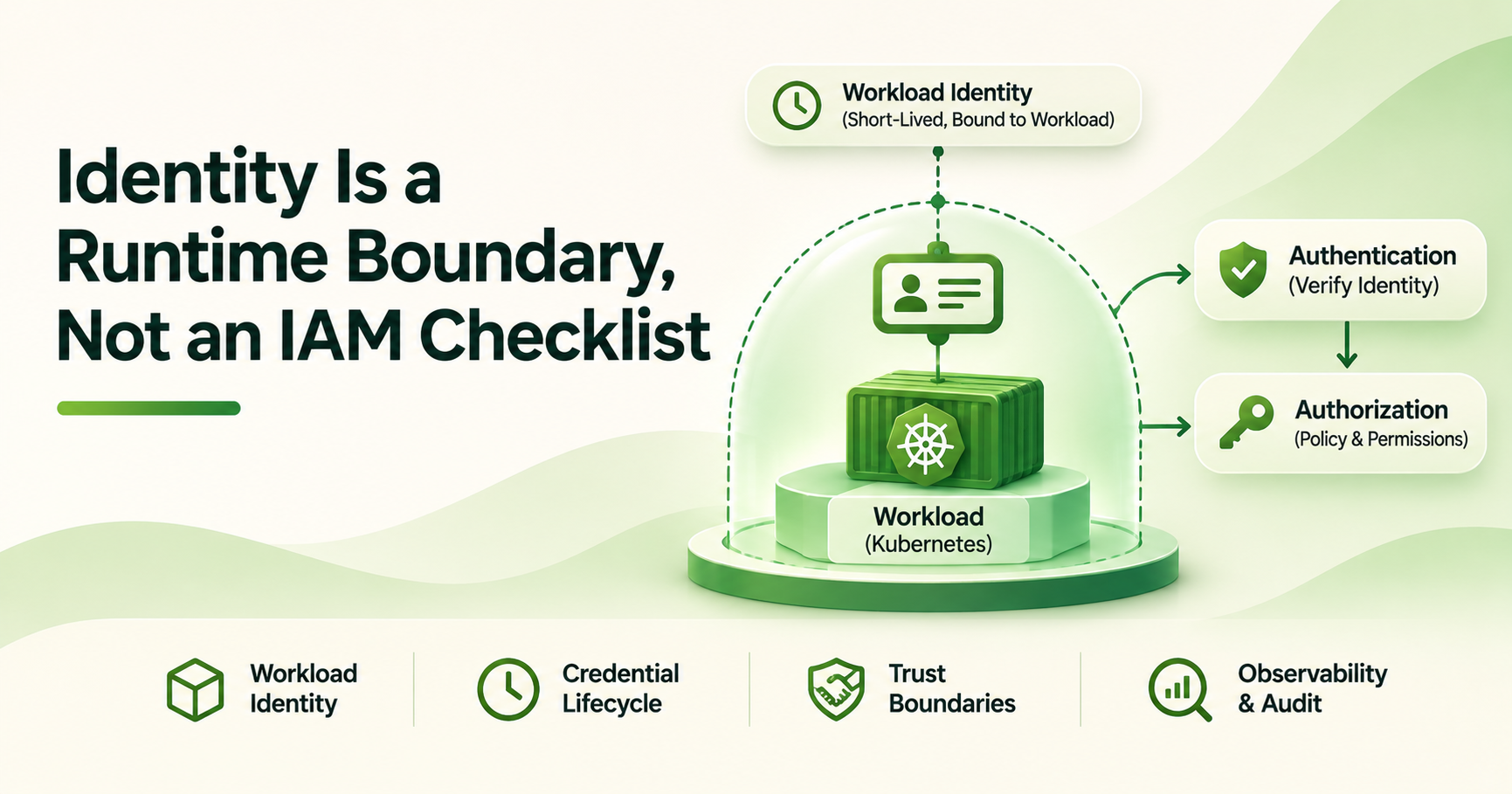
Identity is often treated as a configuration task. A team creates service accounts, assigns roles, configures permissions, and considers access management complete. That approach may be sufficient for a small environment, but it becomes difficult to maintain as applications grow across cloud services, containers, background workers, and distributed systems.
The problem is not simply that permissions become complicated. It is that identity is involved in almost every interaction between running components. A workload needs to establish who it is, prove that identity to another system, receive only the permissions it requires, and maintain that trust as it is deployed, replaced, scaled, or terminated.
This makes identity a runtime concern rather than a one-time IAM configuration exercise. For security and platform architects, the important question is not just whether a workload has the correct permissions. It is whether the system can establish, verify, and enforce that workload's identity throughout its lifecycle.
Assigning permissions is not the same as establishing identity
An IAM policy describes what a principal is allowed to do. It does not, by itself, explain how a running workload proves that it represents that principal.
Consider an application running in a Kubernetes cluster that needs to access an object storage service. The application must obtain an identity, present evidence of that identity to the cloud provider, and receive credentials or authorization that permit the requested operation.
Each step has a different responsibility. Identity establishes who is making the request. Authentication verifies that claim. Authorization determines whether the authenticated principal can perform the requested action.
Combining these responsibilities into a single permission checklist makes it harder to identify where a security failure occurs. A workload might have an appropriately restricted role but still use credentials that are shared with other workloads. Alternatively, authentication might succeed while an overly broad policy allows access to resources the workload does not need.
A secure design must preserve these boundaries instead of assuming that correct role assignments are enough.
Workloads need identities that belong to them
Long-lived credentials are difficult to manage in environments where workloads are created and destroyed continuously. A static access key stored in an environment variable or configuration file can remain valid long after the original deployment has changed. If that credential is copied into another workload, the organization may lose the ability to distinguish which component actually used it.
The risk increases when several services share the same credential. Revoking access for one service can disrupt unrelated workloads, while investigating suspicious activity becomes harder because logs identify a shared principal rather than the component that initiated the request.
A stronger model assigns identity to the workload itself. The workload receives credentials through a trusted mechanism, and those credentials have a limited lifetime. When the workload is replaced, or its execution context changes, its identity can be renewed or withdrawn without requiring a human to distribute another static secret.
Kubernetes provides one example of this approach through projected service account tokens. Modern Kubernetes versions use short-lived tokens obtained through the TokenRequest mechanism and automatically rotate them when mounted through projected volumes. This is preferable to relying on legacy, non-expiring service account token Secrets.
The important architectural property is not simply that the token expires. The token is associated with a workload context, has an intended audience, and can be validated by the receiving system. That gives the platform more control over how identity is issued and consumed.
Identity must follow the workload lifecycle
A workload does not remain in one state forever. It starts, performs work, scales, gets rescheduled, receives configuration changes, and eventually stops. Identity management has to account for those transitions.
Imagine a worker that is replaced during a deployment. The new instance should not inherit an identity merely because it runs the same application code. The platform must establish that the new instance is an authorized workload and issue credentials appropriate to its execution context.
The same principle applies when a workload is removed. Credentials associated with the old instance should not remain useful indefinitely. If the identity system cannot distinguish the old workload from its replacement, terminating a container may not be enough to terminate its effective access.
This is why credential expiration, rotation, revocation, and workload binding need to be designed together. Expiration limits how long a credential can remain valid. Rotation replaces credentials before they become unusable. Revocation handles cases where trust must be withdrawn immediately or where a workload is no longer authorized.
These mechanisms solve different problems. A short-lived token reduces the exposure window, but it does not automatically guarantee immediate revocation. The validation mechanism and the identity provider's behavior determine how quickly a change in workload state affects access.
A useful identity model separates workload identity from trust
The SPIFFE model offers a useful way to reason about workload identity in distributed environments. It introduces a stable identity format called a SPIFFE ID, while allowing the evidence used to prove that identity to change over time.
A workload can receive an X.509-SVID for certificate-based authentication or a JWT-SVID for token-based authentication. The Workload API provides a way for workloads to obtain their identity documents and associated trust information without distributing long-lived private keys manually.
This separation matters because an identity should describe the workload, not the particular credential currently being used. A certificate may expire and be replaced, but the workload's identity can remain consistent within the trust system.
It also makes trust boundaries explicit. Two services may both have valid identities while belonging to different trust domains. Their ability to communicate should depend on whether the receiving system trusts the issuing authority and whether the requested interaction is authorized.
This becomes particularly important when workloads communicate across clusters, cloud accounts, or organizational environments. Trust should not be assumed simply because two services are part of the same application or use similar naming conventions.
Authentication does not replace authorization
A common design mistake is to treat successful authentication as permission to perform a broad set of operations. Authentication confirms that a workload has presented acceptable identity evidence. Authorization still needs to evaluate what that workload is allowed to do.
For example, two services may authenticate successfully within the same environment, but one may only need to read customer records while the other can update them. Giving both services the same permissions because they belong to the same application removes an important security boundary.
Authorization should therefore be enforced close to the resource or service that owns the operation. The receiving service should evaluate the authenticated identity, the requested action, and the relevant resource context before allowing access.
Cloud workload identity federation can help establish this relationship between an external workload and a cloud identity. A platform can exchange a trusted workload identity for short-lived cloud credentials, while attribute conditions restrict which workloads are eligible to receive them. For example, access can be limited to a particular Kubernetes namespace and service account rather than being granted to every workload in a cluster.
The result is a clearer separation between proving identity and deciding what that identity may access.
What happens when the identity system is unavailable?
Identity architecture is easy to evaluate when every dependency is healthy. The harder questions appear during failures, rotations, and unexpected changes.
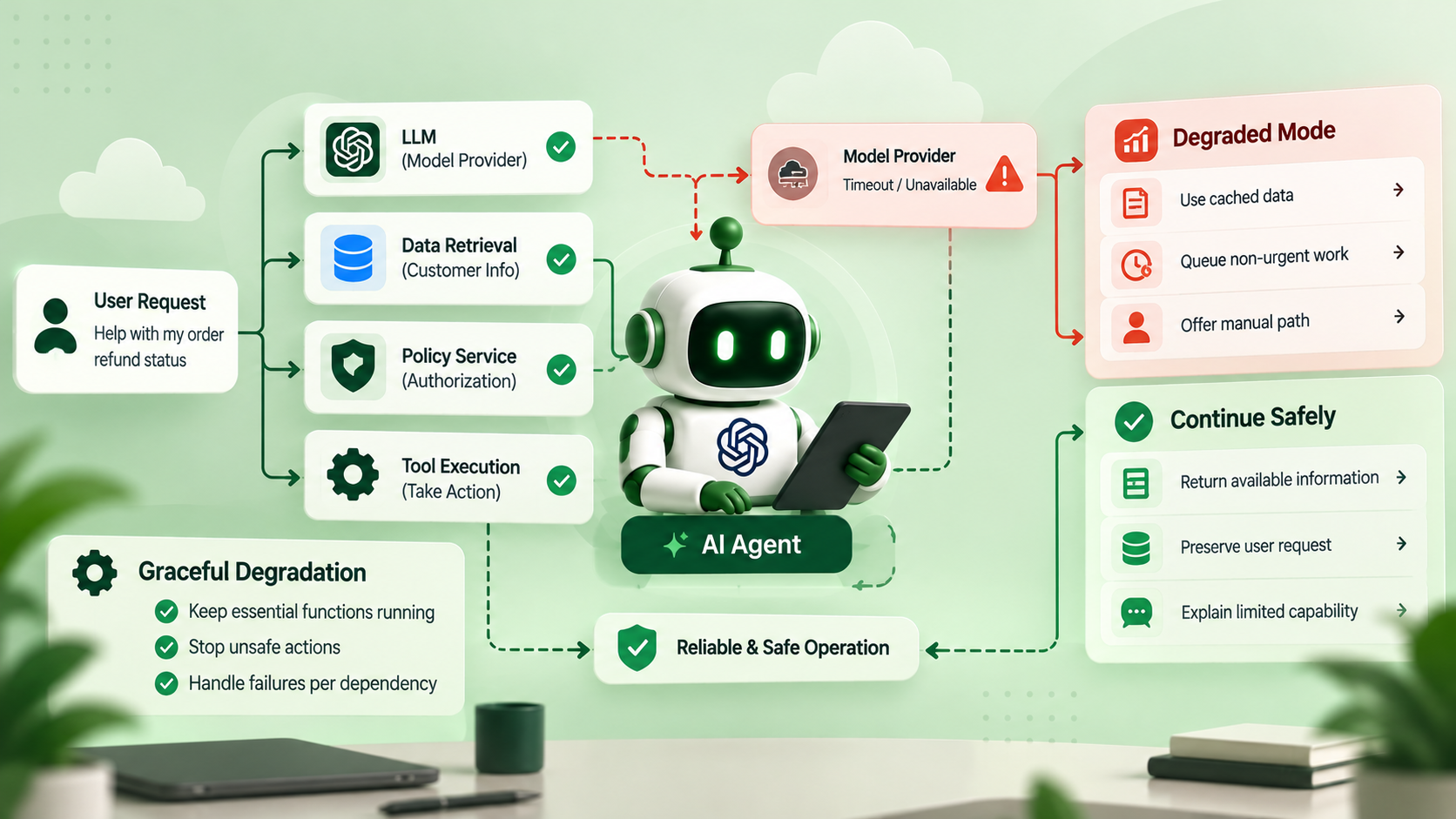
Consider a workload that needs to obtain a new credential while its identity provider is temporarily unavailable. If the current credential is still valid, the application may continue operating until renewal becomes necessary. Once that credential expires, new authenticated requests may fail.
The application needs a defined response to this situation. It should not silently fall back to a static credential simply because the identity provider is unavailable. Such a fallback can turn a temporary availability problem into a permanent security weakness.
A similar issue occurs when a certificate or signing key is rotated. Issuers and consumers must have a compatible transition period so that newly issued credentials are accepted while old credentials are retired. If trust bundles are updated inconsistently, otherwise healthy workloads may begin failing authentication.
Workload replacement introduces another failure mode. A deleted workload may still possess a credential that an external verifier accepts until the credential expires. Some validation paths can check whether a token is associated with a deleted object, while others may rely primarily on token validity and expiry. The distinction affects how quickly access can be withdrawn.
These cases should be tested as operational scenarios, not left as assumptions in a security design document.
Identity decisions need to be observable
When an application request fails because of identity or authorization, a generic access-denied message is rarely enough to diagnose the problem. Engineers need to understand which workload attempted the operation, which identity was presented, which trust relationship was evaluated, and why the request was rejected.
That information should be available through structured logs, metrics, and traces. It should help distinguish an expired credential from an untrusted issuer, a failed token exchange, an authorization denial, or an unavailable identity provider.
Observability must also respect the sensitivity of identity material. Raw access tokens, private keys, and other reusable credentials should never be written into ordinary application logs. Instead, systems should record safe identifiers and decision metadata that allow engineers to investigate the request without exposing secrets.
This is especially important in distributed systems, where a single user operation may pass through several services. If each service records identity decisions consistently, engineers can follow the authentication and authorization path across service boundaries rather than investigating isolated failures.
Reviewing identity as a runtime system
A useful identity review should examine how the system behaves during normal operation and when its assumptions stop holding.
Start by identifying how each workload receives its identity and whether that identity is unique to the workload or shared across multiple components. Then examine how credentials are issued, rotated, validated, and withdrawn. The review should also establish which trust domains are accepted, where authorization decisions are enforced, and what happens when an identity dependency becomes unavailable.
Finally, verify that the system produces enough operational evidence to investigate authentication failures without exposing credential material. These questions connect security design to deployment practices, incident response, and ongoing platform ownership.
The review is incomplete if it only confirms that the right IAM roles exist. It must also demonstrate that identity remains trustworthy as workloads change and that access can be understood and controlled when something goes wrong.
Identity is part of the system's runtime contract
Modern applications are made up of components that communicate across infrastructure and organizational boundaries. Each interaction depends on a reliable way to establish who is making the request and what that component is permitted to do.
An IAM policy is one part of that design, but it cannot carry the entire responsibility. Workload identity, credential lifecycle, trust distribution, authentication, authorization, and observability must work together.
Treating identity as a runtime boundary changes the questions engineers ask. Instead of asking only whether a service account has the correct role, they ask how the workload proves its identity, how that proof is validated, how access changes when the workload changes, and how the system behaves when trust can no longer be established.
That is the difference between configuring access and operating an identity system.
About the author
We’re a digital engineering team focused on building secure, AI-driven, and scalable systems. From intelligent automation to cloud-native development, we turn complex challenges into powerful, future-ready solutions — one line of code at a time.
Comments
Join the discussionNo comments yet. Be the first to comment.